
The Hunt Turns Into a Struggle Over Limits
Butcher's CrossingThis flow traces the conflict between the hunt’s planned commercial purpose and its escalating slaughter, showing how Miller’s expanding objective turns work, weather, and the men’s survival into a confrontation with his obsession.
increasing Bearing strength in each event
 decreasing
Bearing strength in each eventdecreasingA Controlled Beginning
A Controlled Beginning
Miller’s Method
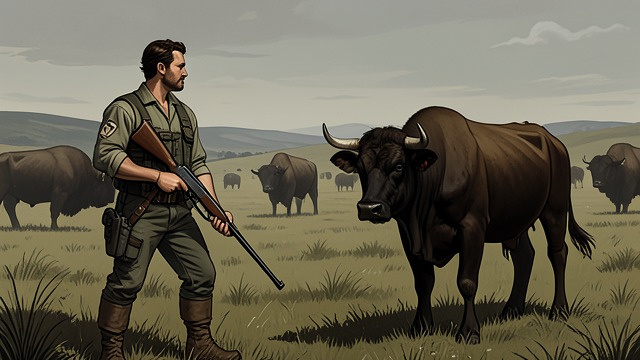
Miller approaches the herd with care, accounts for the wind, and shoots the old lead bull first to keep the bison from running far. He explains how to select a target and how a wounded animal can unsettle the herd. At first, the hunt appears to be a skilled commercial operation governed by experience and control.
Andrews Learns the Work
Andrews watches the animals and the method, then attempts to skin a carcass under Schneider’s instruction. His clumsy first effort costs time and damages a hide, showing that the expedition’s work depends on practical knowledge he does not yet possess. The contrast between Miller’s precise shooting and Andrews’s difficult labor foreshadows how efficiency can make increasingly destructive killing seem ordinary.
The Herd Held in a Circle
The Herd Held in a Circle
A New Scale of Killing
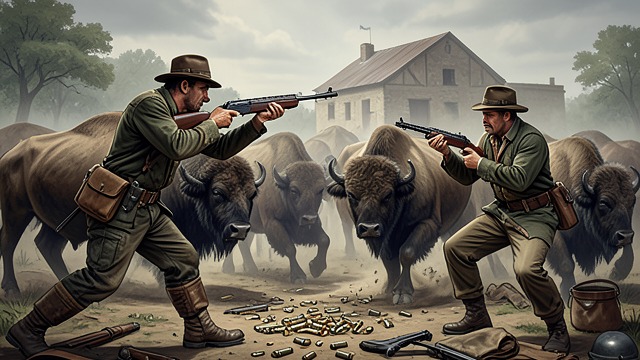
Miller shoots from a fixed position, repeatedly striking animals as the herd circles in confusion after losing its leaders. Andrews reloads the reserve rifle, carries water, and gathers spent cartridges while the shooting continues. The work changes from a hunt for valuable pelts into a sustained process in which the movement of the herd makes more killing possible.
The Limit Is Rejected
Schneider tells Miller that the number already killed is enough to occupy the crew for hours. Miller refuses to stop and says every animal will be skinned, even if the work lasts into the next day. The conflict is no longer merely over method or efficiency: Miller’s appetite for continuing has begun to overrule the expedition’s practical capacity.
The Obsession Revealed
The Obsession Revealed
Schneider Names the Excess
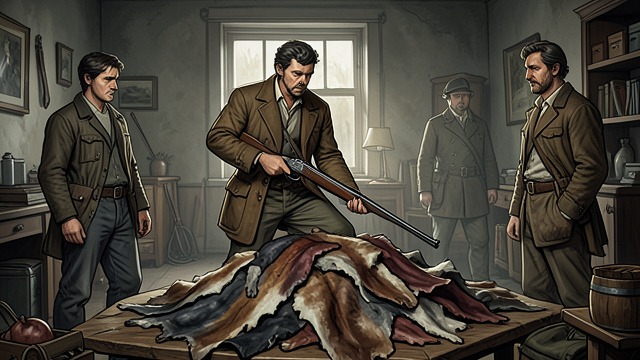
As the men tire of bison meat and the hide piles grow, Schneider argues that the party already has more pelts than it can carry. He asks to leave before the weather turns, but Miller says he intends to destroy the entire herd. Schneider recognizes that Miller is no longer aiming simply to secure a profitable load.
A Conflict Without Restraint
Miller dismisses the objection and asserts that the hunt belongs to him. Andrews has begun to measure their return not by days but by the number of bison Miller still means to kill, and he has difficulty imagining life outside the valley. The men’s positions harden: Schneider sees a needless danger, while Miller treats continuation as the expedition’s purpose.
The Herd’s Attempted Escape
The Herd’s Attempted Escape
A Reduced Herd
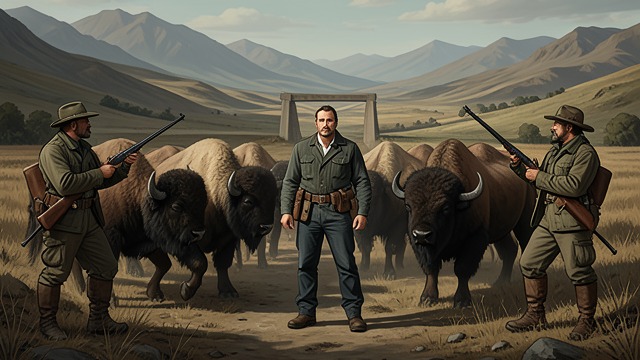
After weeks of shooting, the bison population has fallen from thousands to fewer than three hundred. When smaller herds try to break out of the valley, Miller positions himself between them and the exits, ordering Andrews and Schneider to block the flanks with gunfire. Schneider questions the purpose of preventing the remaining animals from escaping, but Miller presses on.
The Hunt Spills Into Crisis
The men turn back repeated charges, and Andrews experiences the herd not as a collection of targets but as a coordinated force. The episode briefly gives the hunters a defensive task, yet its result is to keep the surviving bison trapped for further killing. Miller’s control over the valley is maintained at the cost of escalating danger and the destruction of what remains.
Snow Ends the Hunt
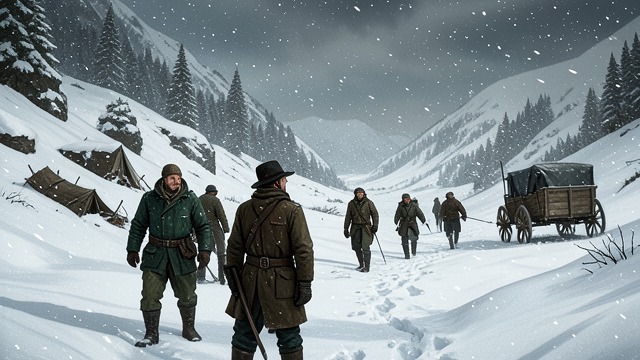
Snow Ends the Hunt
A Warning Ignored
After the final attempted breakout, snow starts falling over the valley. Charley Hoge accuses Miller of having promised the party would finish before winter, while Schneider’s earlier warnings become immediate reality. Miller urges everyone back toward camp, but the weather has arrived before the expedition has completed its work.
The Cost of Continuing
The blizzard drives the party to abandon its wagon and exposes the men to the consequences of spending too long in the valley. The survivors must build shelter and wait months before they can leave, while the remaining herd escapes during the storm. The hunt ends not with the planned haul but with a prolonged struggle to survive, making the weather the force that finally imposes a limit Miller refused to recognize.
The first morning in the hidden valley
The first afternoon of large-scale shooting
Near the end of the second week in the valley
The twenty-fifth day of hunting
Late autumn, as snow begins to fall in the valley
